Published by:
CGP EDU Academic Team
Published on: September 12, 2026
A particle moving along  -axis has acceleration
  at time
  given by
  , where
  and
and  are constants The particle at
  has zero velocity. In the time interval between
  and the instant when
  , the particle's velocity is
A

B

C

D

Text Solution
Verified by ExpertsThe correct answer is:
C
Here acceleration is given by

So,
 When
When 
Hence, from eq. (i), we get

 From eq. (ii), we have
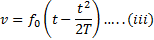
Let us suppose at  acceleration is zero Hence, from Eq. (i),

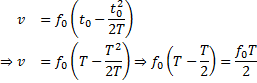
Hence, velocity of particle at  , from è q. (iii),
Prepare Smarter with CGP Edu
Get practice questions, solutions, and test series in one place.
Write a Review
Share your experience with this question and solution.
Commentary
Send your comment, doubt, correction, or feedback to admin.
Similar Questions
Explore conceptually related problems
The velocity (v) of a particle starting from rest increases linearly withtime (t) as , where is i…
If the engine of a long train moving with constant acceleration crosses a tree with velocity ' ' a…
If a person moving along a straight line path covers first half distance with velocity ' ' and the…
If the velocity of a particle moving along a straight line with uniform acceleration, is given by …
Two bodies of masses ' ' and ' ' are dropped from two different heights and respectively. The r…
A person walks up a stalled escalator in . When standing on the same escalator, now moving, he is …